Your ATS Isn't Broken. Your Workflow Around It Is.
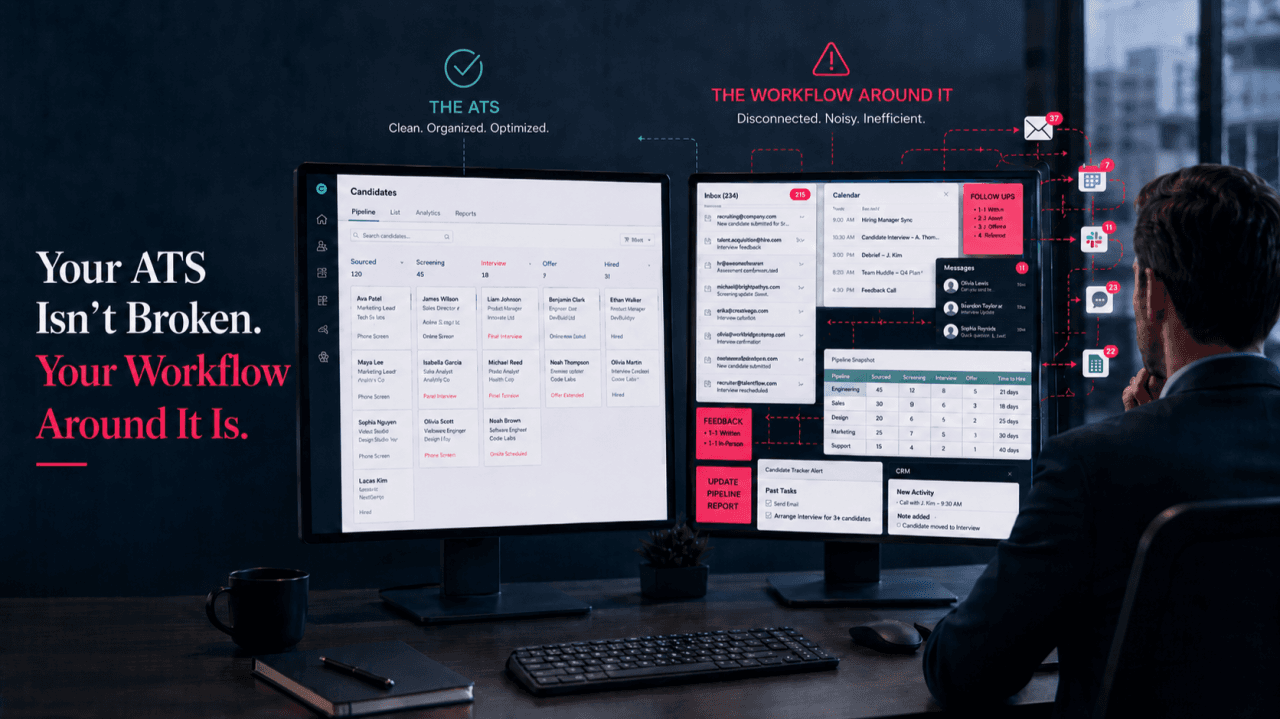
Stop ripping and replacing databases. Start fixing the manual workflows where your recruiters are actually losing time.
Look at your top biller's screen right now.
One monitor has the ATS open. The other has a spreadsheet, three email drafts, a calendar invite that hasn't been sent, and a sticky note that says "chase Marcus Tuesday." That second monitor is where your revenue is quietly leaking. Every single day.
You bought the ATS to get organised. And it worked, the data is in there. But the chaos didn't disappear. It just moved. It moved into your recruiters' inboxes, their heads, and their tab-switching between tools that were never designed to work together.
Recent Totaljobs research, reported by Firefish, found that recruiters spend an average of 17.7 hours per vacancy on manual admin tasks. Not sourcing. Not interviewing. Not closing. Admin. And with hiring timelines already stretched, your team is being asked to push harder without anyone solving the actual drag on their output. That's not a talent problem. That's a workflow problem.
Your tech stack may be storing the data, but the workflow around it is still doing too much manually.
The ATS is not your villain.
The instinct, when things slow down, is to blame the database. But your ATS isn't broken. It's doing exactly what it was designed to do: store candidate records, manage pipelines, and keep you compliant. That's the job. It does the job well.
An ATS is a system of record, not a system of action.
It won't chase a hiring manager who's gone quiet. It won't send a personalised follow up when a candidate's status changes. It won't flag the lead that's been sitting untouched for three weeks. The moment data needs to move needs to trigger something, prompt someone, or turn into a conversation, the ATS hands the baton to your recruiter and expects them to sprint.
Your ATS is an incredible storage system, but expecting it to run your daily operations is like expecting a filing cabinet to write your emails. The database is only as powerful as the workflow surrounding it. And for most agencies, that workflow is still almost entirely manual.
Here's where the time actually goes.
Ask any recruiter to walk you through filling a single vacancy. Reviewing applications, scheduling interviews, chasing hiring managers, updating records, and following up with candidates who haven't heard anything each step requires a person to remember it, act on it, and manually record what happened.
Scheduling is one of the clearest examples. Even without treating any single percentage as universal, the pattern is obvious: calendar coordination is still handled manually far too often, and it consumes recruiter hours that should be going elsewhere.
This is what's usually called the swivel chair effect. Your recruiters spin between the ATS, their inbox, their calendar, and whatever spreadsheet someone built because the CRM didn't quite cover it. Every switch costs momentum. Every manual update is a chance for something to slip. Every follow up that lives in someone's memory instead of a system is a follow-up that might not happen.
Every hour spent tidying data is an hour not spent qualifying a candidate.
The financial case for fixing it.
Manual admin at this scale is expensive at scale. The same Totaljobs research estimated the cost at roughly £17,000 per recruiter per year in lost productivity. Multiply that across your team and the number gets uncomfortable quickly.
The cost isn't just internal. It shows up in candidate experience too. Slow processes mean slow responses. Slow responses mean candidates accept other offers. The ones with the most options move fastest and they're the ones most worth placing.
You aren't just losing time to manual scheduling. You're losing strong candidates to competitors who responded sooner.
Speed of response is a competitive advantage in recruitment. Right now, disconnected workflows are making most agencies slower than they need to be.
The market tried to fix it. Partly.
Research from SHRM found that 43% of organisations now use AI in some capacity for HR related tasks. The vendor's response to that demand produced a market full of useful but narrow tools.
ATS platforms store and track candidate records. CRMs manage client relationships. Scheduling tools reduce calendar back-and-forth. Chatbots handle high-volume initial questions. AI tools can assist with screening, drafting, or communication. Dashboards create visibility for managers.
Each of these tools solves something real. The problem isn't that they don't work. The problem is that they often don't behave like one connected workflow unless someone has designed and integrated the workflow properly.
The recruiter becomes the API.
They move data from the ATS to the email. They copy the note from the call into the record. They check which leads haven't been touched. They remember who needs a follow up. They are the connective tissue between tools that were built in silos.
And it shows in the results. SHRM's 2025 research on AI in HR found that 89% of HR professionals using AI in recruiting report that it saves time or increases efficiency but a significantly smaller proportion describe their implementation as highly successful. That gap between "saves some time" and "genuinely changed how we work" is the workflow layer. It's where the tools run out and the manual effort begins again.
Most agencies don't need more software. They need the software they already have to start working together.
What an automation layer actually does.
This is where the thinking needs to shift. Not replacement. Not a new platform. A layer that wraps around the ATS you already trust and fills the gaps where manual effort currently lives.
In practice, that means a connected workflow that can capture new candidate or client inquiries and route them to the right recruiter automatically without anyone monitoring an inbox. It checks for missing fields in records and prompts the update before the gap causes a downstream problem. It assigns ownership based on role, territory, or workload without a manager having to do it manually. It updates the ATS or creates tasks when a stage changes. It alerts the team when a candidate has gone cold or a client inquiry has been sitting untouched for too long.
It can draft follow up messages for recruiter review so the communication still sounds human, but the recruiter isn't starting from a blank page. It triggers reminders at the right point in the pipeline rather than relying on someone to remember. And it gives managers visibility into where things actually stand, without asking recruiters to manually report everything upward.
None of this replaces the recruiter. All of it removes the administrative drag that stops them from doing what they're actually good at.
Imagine a workflow where your ATS is the brain, but automation is the nervous system, moving information without your recruiters having to carry it themselves.
Where humans have to stay in the room.
A word on where automation should stop.
Logistics, routing, reminders, status updates, and draft communications automation handle those well. The judgment calls, the relationship management, the read on a candidate's motivation, and the final hiring decision stay with the recruiter.
Regulators and researchers have warned that automated hiring tools can create discrimination, transparency, and trust risks if used without proper oversight. When algorithms are applied to hiring decisions without human review, the risk isn't theoretical, it's one that employment regulators and legal frameworks are actively addressing.
Automation should coordinate the interview. A human must make the hire.
The most effective model keeps humans accountable for decisions while automation handles the operational layer underneath them. That's not a limitation of the technology. That's the right design.
Before you change anything, map the workflow you already have.
Don't audit your software stack first. Audit your workflow.
Ask your recruiters: what's the most repetitive task you do every day that adds the least value? It almost always involves moving information between systems, chasing something that should have been automatic, or updating a record that nobody checks until something falls through the cracks.
Before you replace your ATS, map the work happening around it. The real leak is usually not inside the database. It's in the follow ups, the handoffs, the reminders, the updates, and the actions that still depend on someone remembering what to do next.
That's the gap worth closing.
Your ATS isn't broken. It's time to fix the workflow around it so your recruiters can get back to what they do best: placing great people.